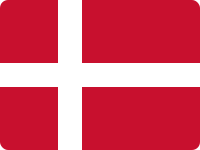
 DKKDanish Krone
Danish Krone (DKK)
The Danish krone is Denmark's national currency and the unit used within a formal exchange-rate relationship with the euro through ERM II.
- ISO code
- DKK
- Symbol
- DKK
- Region
- Europe
- Currency type
- Fiat currency
- Exchange system
- DKK participates in ERM II with a central rate of 746.038 kroner per 100 euro and an agreed narrow fluctuation band. A CurrencyHub provider rate is a separate dated market reference, not the official central rate itself.
- Last reviewed
Convert this currency
DKK converter
DKKRate date:
Quick facts
DKK at a glance
Currency profile
How DKK works
The Danish krone is Denmark's national currency and the unit used within a formal exchange-rate relationship with the euro through ERM II.
Danmarks Nationalbank issues Danish banknotes and uses monetary-policy instruments to keep the krone stable around its ERM II central rate against EUR.
- DKK is divided into 100 ore and remains Denmark's currency even though Denmark is an EU member.
- Its ERM II agreement uses a central rate of 746.038 kroner per 100 euro with a narrow bilateral fluctuation band.
Context
Why this currency matters
DKK illustrates a monetary arrangement that is neither euro adoption nor an unrestricted float. Denmark keeps its own notes, coins and central bank while using ERM II and a narrow band to stabilize the krone against EUR, a distinction that matters when interpreting provider reference rates.
Monetary framework
Exchange arrangement
DKK participates in ERM II with a central rate of 746.038 kroner per 100 euro and an agreed narrow fluctuation band. A CurrencyHub provider rate is a separate dated market reference, not the official central rate itself.
CurrencyHub shows daily reference rates. Banks, card networks, ATMs and transfer providers may apply different exchange rates, fees or spreads.
History timeline
Key dates for DKK
Danmarks Nationalbank established
The national bank was established to rebuild confidence in Denmark's monetary system.
Danmarks Nationalbank - historyDanish krone introduced
Denmark adopted the krone under the Scandinavian Monetary Union, replacing the rigsdaler.
Danmarks Nationalbank - historyERM II relationship began
The krone entered ERM II with a central rate against the newly introduced euro.
Danmarks Nationalbank - history
Usage and economy
How DKK is used
- Prices, payroll and payments in Denmark.
- Nordic commerce and euro comparisons involving SEK, NOK and EUR.
Country currency guides
Banknotes and coins
DKK currency units
Danmarks Nationalbank documents the valid Danish banknote series.
Danmarks Nationalbank documents krone and ore coins used in circulation.
One Danish Krone unit is recorded with 2 decimal places and uses Ore as its minor unit.


Related currencies
Currency relationships
Explore currencies connected through regional use, trade comparisons or monetary relationships.
FAQ
DKK questions
Why does Denmark use DKK instead of EUR?
Denmark retains the krone under its EU treaty arrangements and uses ERM II to support a fixed exchange-rate policy against the euro.
Is DKK fixed exactly to EUR?
DKK has an ERM II central rate and narrow fluctuation band; market rates can move within the supported arrangement.
What currency did the Danish krone replace?
The krone replaced the rigsdaler when Denmark joined the Scandinavian Monetary Union in 1875.
Sources
Data and editorial review
Rate source: Frankfurter
Last reviewed:
Currency identity and cash information is checked against central-bank, government, ISO and official international sources.